







3 Historic Wins: Colombia Poverty Reduction Hits Lowest Level Since 2000
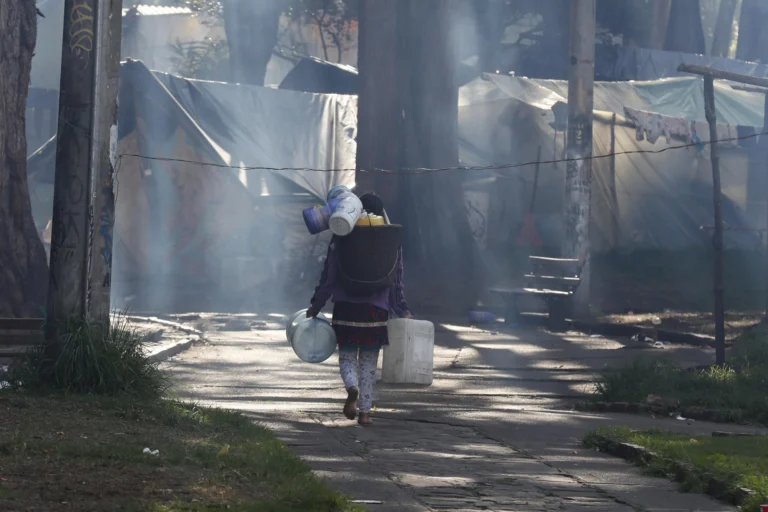
Official data shows 1.8 million Colombians exited monetary poverty in 2025, with extreme poverty dropping below 10 percent.
June 13, 2026 Hour: 1:31 pm
🔗 Comparte este artículo
Colombia poverty reduction reaches historic levels as 1.8 million people exit monetary poverty in 2025, with extreme poverty dropping below 10 percent.
Related: 3 Strong Signs U.S. Interference in Colombia Is Triggering Backlash
Colombia poverty reduction reached historic levels in 2025, with official data showing that 1.8 million Colombians exited monetary poverty during the year. The monetary poverty rate fell to 28%, compared to 31.8% in 2024, according to the National Administrative Department of Statistics (DANE).
Colombia poverty reduction and the official DANE data
The government of President Gustavo Petro, through DANE, announced Friday that approximately 14.4 million people remained in monetary poverty in 2025, while in 2024 the figure was 16.2 million people. This means an estimated 1.79 million fewer people in monetary poverty condition between 2024 and 2025.
Monetary extreme poverty stood at 9.6%, representing a decrease of 2.1 percentage points compared to 2024, when it was 11.7%. Nearly one million people exited extreme poverty in a single year, as the number of inhabitants in that condition dropped from 5.97 million in 2024 to 4.97 million in 2025.
DANE pointed out that there was also a reduction in inequality, as the Gini coefficient, which measures income concentration, fell from 0.551 in 2024 to 0.531 in 2025. The agency attributed this variation to a decrease in household income inequality, marking a significant shift in Colombia’s economic distribution.
Poverty in municipal capitals dropped from 28.6% to 24.6%, while in populated centers and scattered rural zones it decreased from 42.5% to 39.5%. However, these territories still register poverty levels 1.6 times higher than cities, revealing persistent geographic disparities in the country’s development.
Colombia poverty reduction and Petro’s historic claims
President Gustavo Petro celebrated the results and said that, with DANE’s official data, his government has managed to take four million people out of monetary poverty since he assumed power in August 2022. “As of December 31, 2025, with DANE’s official data, and before even decreeing the vital wage, I have taken four million people out of monetary poverty from the day (ex-president Iván) Duque left,” Petro added.
He said he reached “four million people, who will become five million by August 6, 2026 when I leave you,” and highlighted that one million people exited extreme poverty during his administration. This represents the most significant poverty reduction in Colombia’s recent history, according to the president’s statement.
“This is my achievement and I am proud. It is the lowest percentage of monetary poverty and extreme poverty of the entire 21st century,” the head of state affirmed. Petro’s claim positions these results as a historic turning point in Colombia’s social policy, contrasting sharply with previous administrations.
The minimum vital wage was decreed during Petro’s administration, representing the largest increase in decades and feeding internal demand to boost national production. This policy, combined with agrarian reform and energy transition measures, forms the core of the government’s poverty reduction strategy.
In the countryside, agrarian reform advanced with the delivery of more than 700,000 hectares to campesino, Indigenous, and Afro-descendant families. The energy transition stopped being discourse, as for the first time in decades, non-extractive exports exceeded extractive ones, marking a shift toward productive sovereignty.
Geopolitical context
Colombia poverty reduction matters beyond domestic statistics. The results challenge the traditional primary-export and socially exclusionary paradigm that Colombia carried for decades. Petro’s government broke with that model and installed a new logic where the state directs the economy and priorities are ordered by who needs them most.
For the region, these results offer a counter-narrative to the neoliberal model that has dominated Latin America for decades. If poverty reduction and inequality下降 can be achieved through state-led redistribution and social investment, it provides a model for other countries facing similar challenges. This is significant in a region where poverty has rebounded after the pandemic.
The episode also intersects with broader debates about development sovereignty and productive transformation. Colombia’s shift from extractive to non-extractive exports signals a move away from dependency on international commodity prices, which have historically shaped the country’s economic fate.
Author: JMVR
Source: Agencias