







President Maduro’s Legal Team Seeks Case Dismissal in U.S. Court
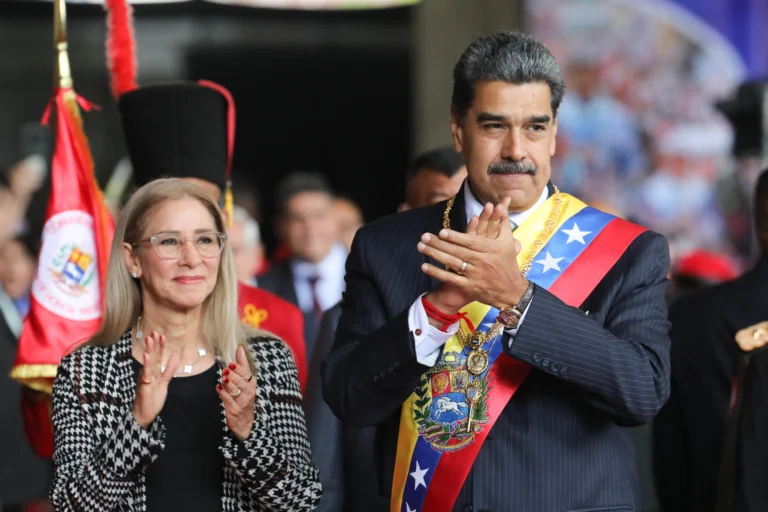
(FILE) On March 26, a hearing is convened to hear President Maduro’s defense lawyer.
March 20, 2026 Hour: 3:46 pm
🔗 Comparte este artículo
The central argument of the Venezuelan President’s lawyers for the dismissal request presented is that Washington actively violates the 6th Amendment and the due process, guaranteed to all defendants on U.S. soil.
The legal team representing Venezuelan President Nicolas Maduro and his wife, the First Combatant Cilia Flores, stated in a document -sent on Tuesday to the U.S. Federal Court- a legal request to dismiss their alleged case in the country, asserting Washington’s sanctions violate their constitutional rights by blocking access to funds necessary for their legal defense.
RELATED: President Maduro Sends Message of Faith and Popular Organization From Kidnapping in New York
The central point of this request for dismissal is the Treasury Department’s decision earlier this year to revoke licenses that allowed defendants to receive payments from the Venezuelan Government to cover legal expenses.
OFAC Sanctions, Dismissal Solution
The motion argues that the U.S. Government’s actions -through the Office of Foreign Assets Control (OFAC) imposed by the Treasury Department- had obstructed the use of Venezuelan State funds designated to pay their legal representatives, which constitutes a direct and unconstitutional interference with the defendants’ ability to mount an effective legal defense.
These actions, as their lawyers Barry Pollack and Mark E. Donelly contend, prevent President Nicolas Maduro and Cilia Flores from “freely choosing their legal representation” and deny them their Sixth Amendment right to counsel of choice and their Fifth Amendment right to due process.
“The only solution is dismissal”, President Maduro’s lawyers wrote, asserting that compelling the defendants to rely on court-appointed lawyers cannot remedy what they describe as a constitutional violation.
The document titled “Response of Nicolás Maduro Moros and Cilia Flores de Maduro to the Government’s opposition to their requests for dismissal of the indictment due to the United States Government’s interference in their recognized Sixth Amendment and due process rights” presented by attorney Barry J. Pollack was filed under case number S4 11-CR-205 (AKH).
The defense lawyers also raises serious questions regarding the consistency and management of the licensing process by the U.S. Government. According to the lawyers, the Treasury Department initially issued permits for the payment of legal fees, only to revoke them later.
At times, officials reportedly described the original approvals as administrative errors; at other junctures, they cited broader policy considerations following consultations with the State Department. These shifting explanations, the defense argued, strongly had suggested that the decision may have been arbitrary or politically motivated rather than based on consistent legal principles.
Furthermore, the defense points out that the Treasury Department has continued to authorize other transactions involving Venezuelan funds -including commercial and other legal activities- even while it has blocked payments in this particular case, reinforcing doubts about the uniformity and fairness of the policy applied.
The document specifies that on January 3, 2026, U.S. special forces and air assets attacked Venezuela, caused more than 100 deaths, event which resulted in the illegal kidnapping of President Nicolás Maduro and his wife, the First Combatant Cilia Flores, forcibly transferred to U.S. territory.
President’s Defense, State Obligation
The defense emphasized that under the Venezuelan law, the State is obligated to cover the legal costs of the legal process, creating a property right that U.S. authorities are allegedly blocking illegally.
“Venezuelan law grants Mr. Maduro and Mrs. Flores de Maduro a property right on the payment of their legal fees. The revocation of the Original Licenses by OFAC and the refusal to restore them interferes with their right to hire the lawyer of their choice since, without the ability to exercise this property right, neither has the ability to finance defense on its own. See Declaration by Nicolás Maduro Moros (ECF No. 290-2) and Declaration. from Cilia Flores de Maduro (ECF No. 293-2) (sworn statements of inability to pay and willingness to submit financial statements at the request of the Court)”, held the legal defense of the Venezuelan President.
Citing rulings such as Luis v. United States and United States v. Stein, the defense argues that the Government cannot interfere with access to legitimate resources for hiring legal counsel. They point out that the U.S. Government does not dispute the lack of personal funds from President Nicolás Maduro and Cilia Flores, nor that the Treasury has allowed third-party payments in similar cases.
This motion underscores the intricate challenges in balancing national security interests with the fundamental rights of defendants in international legal proceedings, particularly when dealing with sanctions and foreign governmental funds.
The defense also criticized the U.S. Government’s proposal of relying on court-appointed lawyers as “no solution at all”, stating it fails to address the fundamental constitutional violations.
“If the interference of OFAC with the capacity of Mr. Maduro to finance his defense persists, the lawyers who subscribe will not be able to stay in the case, nor Mr. Maduro may not be represented by any other hired lawyer”, the Venezuelan President’s defense warned in this context.
The legal brief is further buttressed by a sworn declaration from Venezuelan jurist Henry Rodríguez Facchinetti, who certified that Venezuelan law obliges the State to cover the legal expenses of its President. This legal obligation, coupled with President Maduro’s own sworn statement attesting to his lack of personal funds for his defense, strengthens the argument that the U.S. Government’s blocking of funds directly obstructs a legally mandated payment.
The defense highlighted that this situation contrasts sharply with the U.S. Government’s simultaneous authorization of significant oil and commercial contracts with Caracas, signaling a perceived inconsistency in Washington’s policy application. At the same time, they characterized these scenario as direct political intervention.
This selective blocking of funds for legal defense, while allowing other financial dealings, underscores the defense’s assertion of political motivation behind OFAC’s decision.
This legal challenge aims to underscore that while the U.S. Government may impose sanctions, those actions cannot, under U.S. constitutional law, infringe upon the fundamental rights of a defendant to a fair trial and effective legal representation.
Since his initial arraignment on January 5, President Maduro remains in solitary confinement at the Metropolitan Detention Center in Brooklyn, awaiting trial for the Fourth Amended Indictment.
Author: Laura V. Mor
Source: Agencies