








The Multipolar Moment: What U.S. Hegemony Decline Means
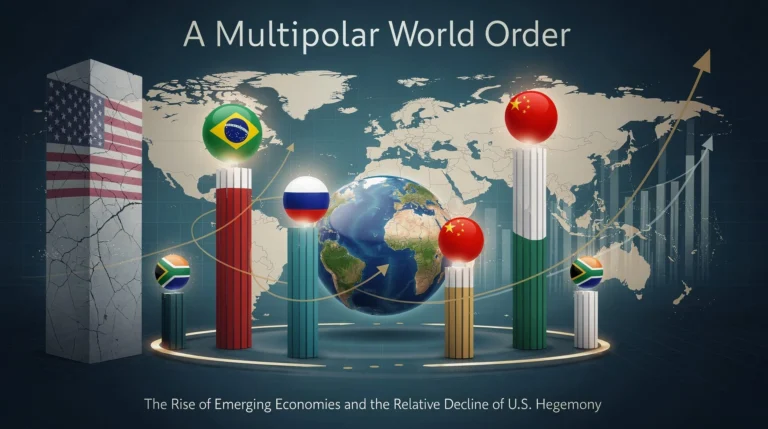
Image created with AI by AskToAI.
By: Atilio Borón
March 29, 2026 Hour: 10:24 pm
🔗 Comparte este artículo
The events of recent years have witnessed a major transformation of the international system. The balance of power that had prevailed since the collapse of the Soviet Union—marked by the uncontested dominance of U.S. unipolarism—eroded steadily and at an ever-accelerating pace as actors and countries on the periphery became thriving centers of economic growth and protagonists of formidable technological advances. We are referring, without naming it, to China, but also to Russia, India, and to a lesser extent to a handful of countries in the Global South. Not only that.
The shift in the center of gravity of the global economy from the North Atlantic to the Asia-Pacific region has set in motion a silent revolution whose consequences continue to grow and branch out. Those who argue that a long historical era has come to an end are not exaggerating; over the past five hundred years, the West held undisputed dominance over the rest of the world, which had become an archipelago of colonies and protectorates subjected to centuries of oppression and plunder. But that chapter of history is now closed.
Today, the BRICS countries already surpass the G7 in terms of GDP size when measured, as it should be, by Purchasing Power Parity (PPP). In fact, this group of emerging powers—the original five: Brazil, Russia, India, China, and South Africa—already accounts for 37% of global GDP, compared to the G7’s 30%. With the new members joining in 2025, their share has risen to over 40%, and the trend is becoming increasingly pronounced.
Multiple dimensions of analysis confirm the emergence of a multipolar, or polycentric, international system. Advances in information technology by China and India are relegating the United States to an increasingly distant third place, closely followed by Russia.
The number of STEM graduates (an acronym for Science, Technology, Engineering, and Mathematics) provides data of undeniable eloquence: China graduates 3,570,000 students per year in these fields, which are crucial to the world of computing in all its forms—IA, robotics, cybernetics, and so on; followed by India with 2,550,000, the United States with 820,000, and Russia with 520,000. In other words, for every American graduate, there are more than four Chinese graduates.
As for electricity, an essential resource for the world of computing and all pathos of modern life, China generates approximately one-third of the world’s electrical energy and the United States just 15 percent, followed by India and Russia. China, in turn, is by far the world’s largest exporter and has become, as England was in the 19th century, “the industrial workshop of the planet.”
We could continue to examine a wide variety of indicators, and the overall assessment would remain the same: the world is witnessing a redistribution of global power that calls into question the asymmetries forged in the post-World War II era—whether in the context of the U.S.-USSR bipolarity or the “unipolar moment,” as the brief period following the collapse of the Soviet Union was termed- which came to an end with the attacks of September 11, 2001. In this new configuration of global power, economic might is no longer concentrated in the collective West; of course, the West remains an important actor, but the Asia-Pacific region is far more so. In the realm of cutting-edge technologies, the United States has been losing ground to China and, in certain sectors, to India. The dollar, once the sole reserve currency in the global economy, has been losing ground slowly but steadily, facing competition from other currencies, primarily the euro and the yuan.
Currently, approximately 57 percent of global reserves are denominated in dollars; in the 1950s, with the dollar convertible into gold at a rate of $35 per ounce, the dollar was the reserve currency for nearly 90 percent of the economies of the so-called “free world”—that is, the economies outside the Soviet economic sphere that were ruled by the Bretton Woods agreements. In 1971, President Richard Nixon ended convertibility, and since then the U.S. currency has been accepted assuming that the U.S. economy would remain the world’s largest and most stable and that the dollar would maintain its value over time. But the reality is that this did not happen and the dollar is in sharp decline. Today, an ounce of gold is trading at around $4,500.
This devaluation of the U.S. dollar can be attributed, among other things, to continuous trade deficits, the effects of deindustrialization, the parasitic dominance of financial speculation, and, above all, the White House’s staggering debt. In March 2026, U.S. public debt surpassed its all-time high, reaching $39 trillion (that is, 39 million of million dollars), which represents more than 120% of the American GDP projected for this year.
This debt is driven by the high fiscal deficit caused, among other things, by the regressive nature of a tax system in which big capital enjoys significant exemptions while the rest of society supports, through its taxes, the functioning of the state and its exorbitant military budgets. Warren Buffett, one of the wealthiest U.S. citizens in the world, has been calling for years for a significant increase in taxes on millionaires and large corporations to preserve the existence of the middle class in his country, which, according to him, pays more taxes than millionaires—who benefit from all sorts of subsidies and tax exemptions.
Preventing the impoverishment of the middle class is a categorical imperative for strengthening mass consumption, stimulating corporate sales, and bolstering the flagging legitimacy of the capitalist economy, especially among young people. Due to this combination of factors, the interest the U.S. government must pay on the public debt now equals the phenomenal defense spending: $970 billion, tripling compared to the interest paid in 2020 due to the unstoppable rise in debt and the increase in interest rates implemented by the Fed since 2022.
One of the most striking features of the emerging multipolar system is the decline of the United States as a superpower. It undoubtedly remains a very powerful country, but it no longer has the capacity to prevail as it once did. Its power is increasingly based on its military might—undoubtedly the greatest on the planet but that did not allow it to win in Vietnam, Afghanistan, Iraq, Lebanon, and Somalia- but, as already noted, its economy faces numerous problems and its ruling class is deeply divided.
Trumpism has dealt a fatal blow to the much celebrated “bipartisan consensus” that for decades served as the foundation for the continuity of American supremacy on the world political stage. Today, its diminished dominance rests more on its military strength than on its hegemonic capacity.
Under Trump, its traditional alliances, especially with European countries, have dissolved, and its “soft power”—manifested in its growing international disrepute, its inconsistency in dealing with allies, and its lost leadership in technology—has significantly eroded. Trump also to destroyed the famous “rules-based world order” by violating every single one of those rules with his reckless administration. Wars not authorized by the U.S. Congress; extrajudicial killings in the Caribbean and the Pacific of alleged “drug-smuggling boats” without any evidence to support that accusation; the bombing of Caracas and La Guaira and the kidnapping of President Nicolas Maduro Moros in Venezuela, in gross violation of the United Nations Charter and the principles of international law; the attack on Iran in June of last year and open warfare since February 28 of this year while diplomatic talks were underway to end the conflict, in an act of unforgivable treason. If we add to this the threats Trump utters daily—from taking over Cuba, seizing Greenland, “reclaiming” the Panama Canal for the United States, and the endless litany of announcements of tariff and duty hikes—the international landscape could not be more turbulent, with Israel carrying out open-air genocide with total impunity, relying on the financial, diplomatic, and military support of Washington and the countries of the European Union
Given these circumstances, it is strikingly surprising that powerful countries such as those in the BRICS bloc have not come to the aid of Cuba, which is subjected to brutal aggression—a genocide as defined by the UN—and have accepted without major complains the United States’ imposition of sanctions and its threats against anyone who dares to transport fuel and other goods to the island. How is it possible that Russia, China, India, and even Brazil accept Trump’s threats? Does anyone believe that the United States would start a Third World War because an oil tanker is sent to Cuba? What could be the punishment for those who come to the aid of the rebellious island? Sanctions, new tariffs, a diplomatic break? What significance could such measures have for countries like those mentioned, which in turn possess powerful mechanisms for retaliation, such as raising tariffs on products from the United States? If the main players in the new international political landscape behave as obedient and submissive witnesses to U.S. arrogance, limiting themselves to issuing loud but ineffective statements in response to crimes such as the current comprehensive blockade against Cuba, Washington will not hesitate for a moment to lash out with full force against those countries.
Nothing exacerbates the empire’s bellicosity more than the weakness or hesitation of its rivals on the international stage. And it won’t take long for it to nip emerging multipolarism in its cradle. It is worth recalling here Henry Kissinger’s famous dictum when he said that “To be an Enemy of America is Dangerous but to be a Friend is Fatal.”
Author: Atilio Borón
Source: teleSUR
The opinions expressed in this section do not necessarily represent those of teleSUR