







Venezuelan Acting President Enacts Amnesty Law After National Assembly Approval
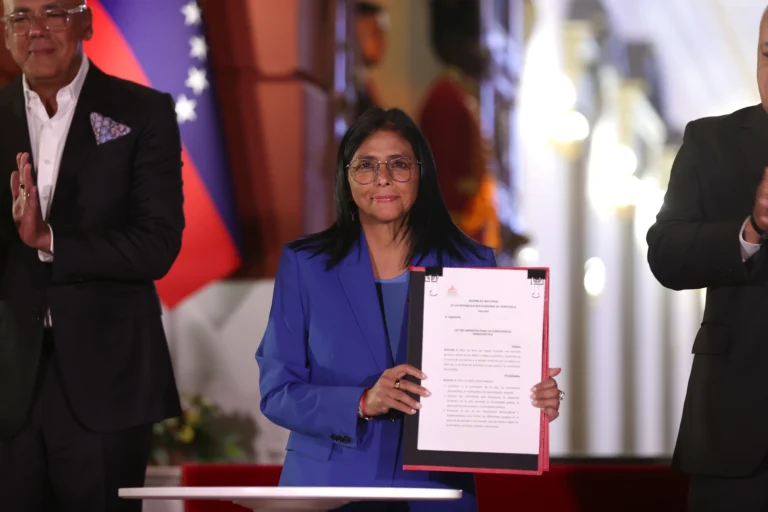
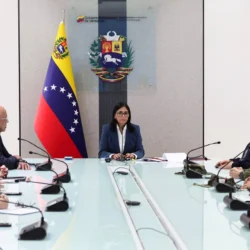
Acting Pres. Rodriguez claimed that violence for political purposes led to hate crimes and justified external aggression against Venezuela, and considered that the approval of the Amnesty Law has demonstrated political maturity. Photo: EFE.
February 19, 2026 Hour: 11:57 pm
🔗 Comparte este artículo
Adopted unanimously by the Venezuela’s National Assembly, the Amnesty Law covers political events from the 2002 coup d’état to the 2025 regional elections, but explicitly excludes the most serious crimes.
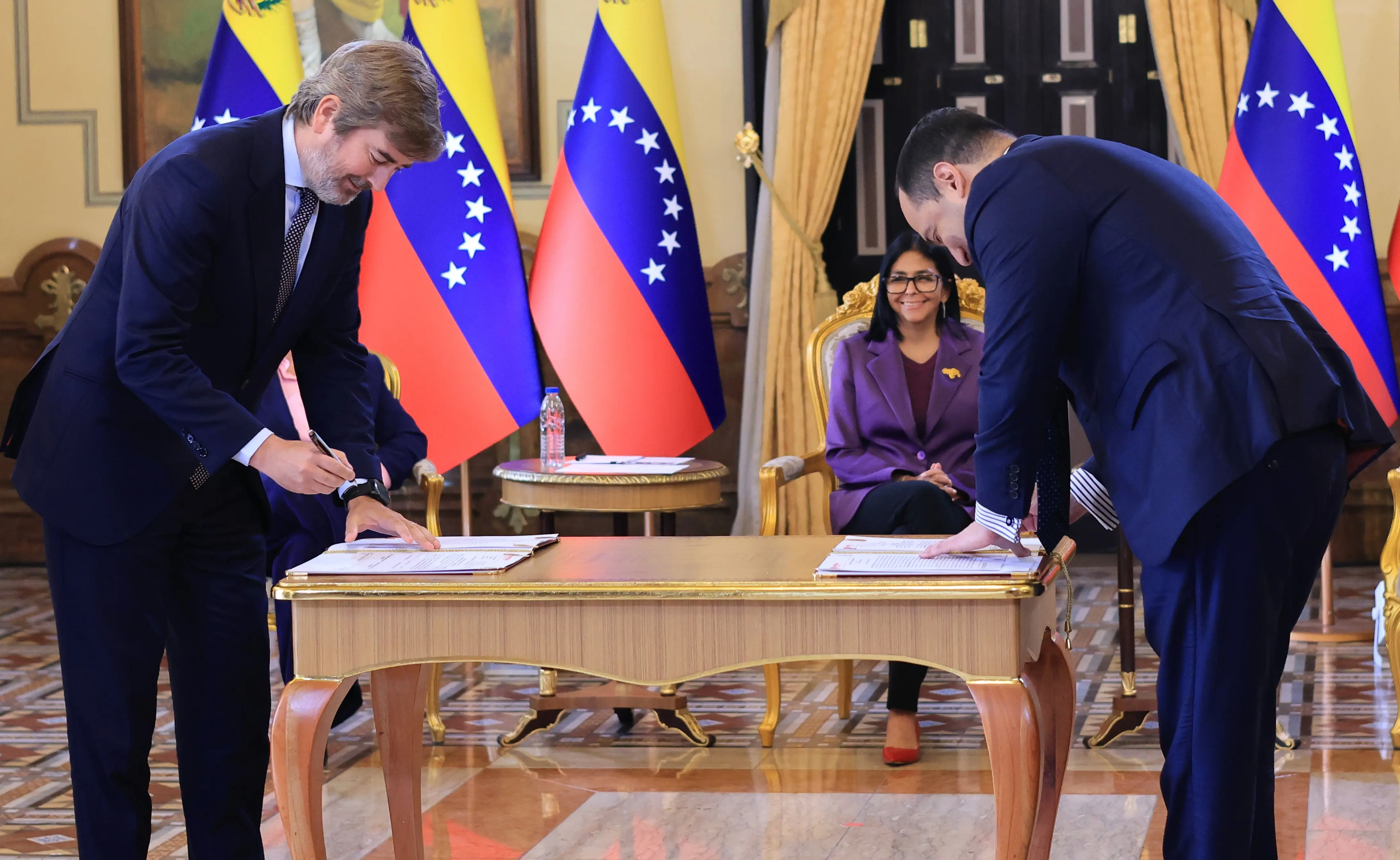
The Venezuelan Acting President, Delcy Rodriguez, promulgated on February 19 the Amnesty Law for Democratic Coexistence, after the National Assembly unanimously approved that in its second reading on, marking a milestone in the country’s democratic history.
RELATED: Venezuelan Acting President Oversees Communal Development Projects
“This law opens an extraordinary door for Venezuela to meet again and learn how to live democratically and strip itself of hatred; let understanding, recognition prevail. The Amnesty Law goes further”, said Rodriguez.
“We are guaranteeing a future of peace and coexistence for our young people. It is an act of detachment and greatness”, Rodriguez added.
In this sense, she assured that the approval of the law “has demonstrated political maturity of all those who participated” in the process.
The scope of this legal document serves as a precise X-ray of the last two decades of Venezuelan politics, since 2002 to 2025, recognizing that Venezuela had been traversed by profound cycles of political conflict in this years.
Political Facts Covered
The legislation contemplates 13 specific political acts that will be covered by the amnesty and establishes that individuals outside the national territory who are subject to amnesty may be represented before the competent court by a legal representative.
The text indicates that the amnesty covers all persons prosecuted or convicted of crimes or offenses within the framework of the amnestied events, provided they “are in compliance with the law” or “come into compliance” after the law enters into force.
For those not in the country, legal representation will be carried out through a power of attorney granted to a lawyer of their choosing. After submitting the application, the person may not be deprived of liberty for the events covered, although they must appear in person before the Court. The amnesty will only apply to those who have ceased or cease committing the acts constituting the crime or offense.
- 2002 Coup d’état: Crimes committed in the context of the coup d’état of April 2002 (11 and 12), including assaults and attacks on governorates, mayors’ offices and public and private facilities.
- Oil sabotage (December 2002 – February 2003): Facts related to oil sabotage to Petroleos of Venezuela (PDVSA) that paralyzed economic activity for almost three months are included.
- 2004 Presidential recall referendum: Crimes arising from politically motivated demonstrations and violent events that occurred during the convening and holding of the presidential recall referendum in 2004.
- 2007 violence: Crimes related to politically motivated demonstrations and violent events that took place in May 2007 are covered, a period marked by tensions around institutional decisions that agitated the public agenda in Venezuela.
- Political riots between July and September 2009: Events related to demonstrations and acts of political violence that occurred between July and September 2009, in a climate of turmoil that spread through several regions of the country.
- Presidential election – April 2013: Crimes linked to politically motivated demonstrations and violent events generated after the presidential election of April 2013 and the proclamation of its results.
- Protests from February to June 2014: Crimes related to politically motivated demonstrations and violent events between February and June 2014, wich left dozens killed and hundreds detained.
- Proceedings of the National Assembly 2016-2020: Conduct related to the National Assembly installed for the 2016-2020 period and the ignorance of public institutions and authorities.
- Protests from March to August 2017: Crimes related to politically motivated demonstrations and violent events that occurred between March and August 2017, a lapse that concentrated one of the most violent cycles in the country in the last two decades.
- Events from January to April 2019: crimes related to politically motivated demonstrations and violence between January and April 2019, that excludes the crime of military rebellion.
- Internal presidential candidate selection – 2023: Events related to the convening and conduct of internal processes for the selection of presidential candidates that took place in 2023.
- Political violence in the framework of the 2024 presidential elections: Crimes linked to politically motivated demonstrations and violent events that took place in the framework of the presidential elections of July 2024.
- Regional elections and 2025 National Assembly elections: Crimes related to demonstrations and violent events for political reasons that occurred within the framework of regional elections and for the National Assembly held in 2025.
Crimes Excluded
The recently passed law is not an amnesty without conditions: although it allows to be beneficiaries to those people who engaged in conduct linked to political conflict, it firmly excludes crimes that, by their own nature, cannot be relativized.
Actions constituting serious Human Rights violations, crimes against humanity, and war crimes are excluded from its application. Likewise, the legislation excludes homicide, drug trafficking, and crimes public or private stipulated in the Law Against Corruption.
Additionally, it excludes individuals who have promoted, instigated, financed or participated in armed or forcible actions against the people, sovereignty and territorial integrity of Venezuela.
Social Reintegration
The legislation guarantees that amnestied individuals can fully resume their lives in society and the public sphere, fostering democratic coexistence, which marks a total social and public reintegration of the beneficiaries.
Therefore, it represents a significant legislative effort to address reconciliation and democratic coexistence in Venezuela by establishing a legal framework for resolving situations arising from past and present political conflicts.
The following step -according the Venezuelan legislation- is the review by the organs of administration of justice and its legal promulgation through the Official Gazette of the country, when it shall come into legal force.
Author: HGV - LVM
Source: National Assembly of Venezuela/ teleSUR